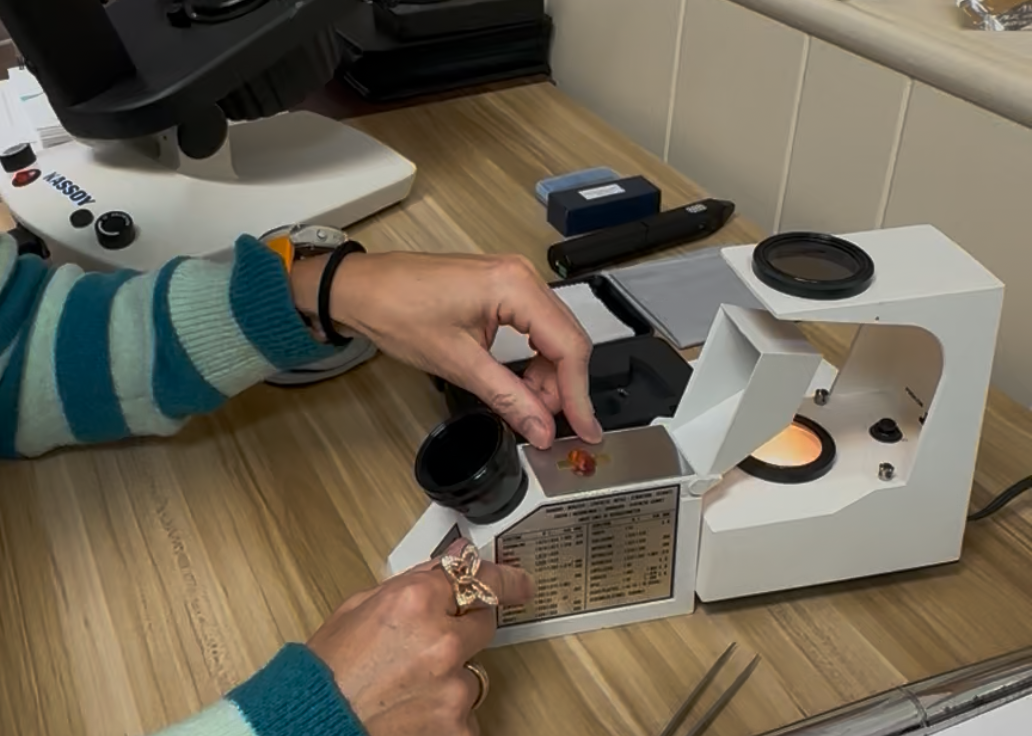
Have you ever wondered what actually happens when you leave your jewelry with an appraiser?
Is it weighed? Measured? Put under a microscope? Do I simply look at it and somehow decide what it’s worth?
There’s quite a bit more to it than that!
A professional jewelry appraisal is part gemology, part research, part documentation—and sometimes a little detective work.
First, We Figure Out What You Have
Before we can talk about value, we need to understand exactly what the piece is.
I examine the jewelry carefully, looking at the metals, diamonds or gemstones, construction, condition, hallmarks, maker’s marks and other identifying characteristics. Depending on the piece, I may use a microscope, gemological instruments, electronic testing equipment, scales and precise measuring tools.
Gemstones are evaluated for characteristics such as color, clarity, cut and estimated carat weight. When appropriate and possible within the limitations of a mounted stone, I also look for indications of treatments and whether a gemstone may be natural or laboratory-grown.
This is where the gemologist and scientist in me gets to have some fun.
Then Comes the Documentation
An appraisal isn't just a dollar amount at the bottom of a page.
Your jewelry is photographed and described in detail so there is a record of what you actually own. Depending on the piece, that description may include gemstone measurements, estimated weights, metal type, markings, condition, design details and other identifying information.
This documentation can be particularly important if a piece is ever lost, stolen or damaged.
So… How Do I Determine the Value?
Here's something that surprises many people: there isn't one universal value for a piece of jewelry.
Before determining a value, an appraiser needs to know the intended use of the appraisal.
An appraisal for insurance purposes, for example, isn't necessarily asking the same valuation question as an appraisal prepared for an estate-related purpose.
Once the appropriate type of value and market are established, I research relevant market information and comparable jewelry. The goal isn't to come up with the highest number possible. It's to develop a well-supported value appropriate for the intended use of the appraisal.
And Sometimes, There Are Surprises
This may be my favorite part of the job.
A client may bring in something they've worn for 20 years and discover an interesting detail they never knew. An inherited piece may turn out to be quite different from the family story surrounding it. And occasionally, the unassuming piece in the bottom of the jewelry box ends up being the one we want to investigate further.
Jewelry has a wonderful way of holding both information and stories.
At CN Appraisals, my goal is to give you more than a number. I want you to leave knowing what you have, having it properly documented, and understanding what the appraisal means.
Because when it comes to jewelry, sometimes taking a closer look makes all the difference.